
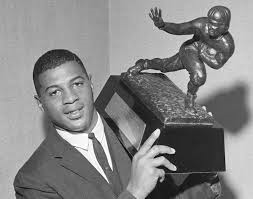
Ernie Davis, an American football halfback at Syracuse University and the first African-American athlete to win the Heisman Trophy in 1961, dies on this day from Leukemia before playing a pro game.
On this day, President Rutherford B. Hayes appointed Frederick Douglass as the U.S. Marshal for the District of Columbia, making him the first Black American to hold this prestigious federal position. The appointment marked a significant step in Douglass’s distinguished public service career and symbolized a brief period of federal support for Black political advancement during the post-Reconstruction era.
On May 18, 1971, President Richard Nixon formally rejected a 60-point policy proposal from the newly formed Congressional Black Caucus (CBC), a group of African American lawmakers dedicated to advancing civil rights, economic justice, and political power. The CBC had sought a direct meeting to present its “Black Declaration of Independence,” which demanded stronger federal action on issues like police brutality, voting rights, urban poverty, and educational inequality. Nixon’s refusal to meet with the Caucus or consider its demands sparked national outcry and highlighted how even post–civil rights America continued to marginalize Black political voices. The incident reinforced the importance of independent Black political advocacy within the U.S. government. May 18 marks a key date in the history of the Black Power era, underscoring how systemic resistance often met the push for racial justice—even within the halls of Congress. The CBC’s persistence paved the way for future Black legislative influence.
Ernie Davis, the star running back from Syracuse University and the first Black player to win the Heisman Trophy (1961), tragically passed away from leukemia just two days later, on May 18, 1962, before ever playing a professional football game.
Yannick Noah, one of the most celebrated Afro-European athletes in tennis history, was born on May 18, 1960, in Sedan, France, to a Cameroonian father and French mother. In 1983, he won the French Open, becoming the first Frenchman to win the title in 37 years—and the first Black male to win a Grand Slam in the Open Era. Beyond tennis, Noah became a beloved public figure, known for his activism, humanitarian work, and musical career in France. He remains an outspoken advocate for racial equality and social justice in Europe. His biracial identity and international success made him a symbol of multicultural progress. May 18 serves as a global Black history moment, reminding us that African heritage and Black excellence know no borders. Yannick Noah’s legacy extends well beyond the tennis court, reflecting the growing influence of the African diaspora across global culture and politics.
Mary McLeod Bethune, one of the most influential African American educators and civil rights pioneers, passed away on May 18, 1955. Born to former slaves in South Carolina, Bethune rose to national prominence by founding the Daytona Educational and Industrial School for Negro Girls in 1904, which later became Bethune-Cookman University. She also served as an advisor to President Franklin D. Roosevelt and founded the National Council of Negro Women. Her legacy is one of relentless commitment to education, racial uplift, and women’s empowerment. Her motto, “Invest in the human soul. Who knows, it might be a diamond in the rough,” continues to inspire generations. Bethune’s work laid the foundation for future civil rights movements and Black-led institutions. Honoring her death on May 18 allows us to reflect on the enduring impact of Black women in shaping America’s educational and political systems. She remains a cornerstone of Black history and leadership.
On May 18, 1946, Reginald “Reggie” Jackson was born in Wyncote, Pennsylvania. He would go on to become one of the most electrifying African American athletes in Major League Baseball history. Known as “Mr. October” for his legendary postseason performances, Jackson’s career included five World Series championships and 563 home runs. He played for the Oakland A’s, New York Yankees, and California Angels, and was inducted into the Baseball Hall of Fame in 1993. Jackson’s career broke cultural barriers, symbolizing the power and presence of Black athletes on the national stage during an era of social transformation. He was outspoken about race and identity, often confronting racism head-on in the media and within baseball’s institutions. Reggie Jackson’s birth on May 18 is a milestone in both sports history and African American cultural achievement. His story highlights the intersection of Black excellence, athleticism, and social commentary in modern American life.
On May 18, 1896, the United States Supreme Court handed down one of the most devastating decisions in Black history: Plessy v. Ferguson. In a 7–1 ruling, the Court upheld the constitutionality of racial segregation under the doctrine of “separate but equal.” The decision stemmed from Homer Plessy’s courageous act of civil disobedience in Louisiana, where he challenged segregation laws by sitting in a “whites-only” train car. The ruling legally sanctioned systemic racism and allowed Jim Crow laws to flourish across the South for decades, institutionalizing inequality in education, housing, transportation, and public services. This judicial endorsement of segregation remained in place until it was finally overturned by Brown v. Board of Education in 1954. May 18 is a key date in African American legal history, reminding us how courts can both reinforce and dismantle racial injustice. Understanding this ruling is essential to tracking the arc of civil rights law in America.
On May 17, 1848, William Alexander Leidesdorff, one of the first prominent Black entrepreneurs and diplomats in early California history, died at the age of 38 in San Francisco. Of Afro-Caribbean and Danish descent, Leidesdorff was a pioneering figure in the development of San Francisco as a major port and was appointed U.S. Vice Consul to Mexico for California under President James K. Polk. At the time of his death, he was one of the wealthiest men in California.
On May 18, 1918, Hayes Turner was lynched in Brooks County, Georgia, in one of the most brutal racial terror campaigns in American history. Turner, a Black man, was accused without due process and murdered by a white mob. His lynching was part of a weeklong wave of violence where at least 13 African Americans were killed. The very next day, his wife Mary Turner, eight months pregnant, was lynched after she publicly condemned the killing of her husband. Her murder was especially heinous and galvanized early anti-lynching activism. The NAACP and Black newspapers documented the atrocity, forcing a national reckoning with racial violence. This grim event underscores the harsh reality of racial injustice and mob rule during the early 20th century in the United States. Remembering May 18 is vital in the context of Black history as it illustrates the cost of speaking truth to power—and the need for systemic change.


© 2026 KnowThyHistory.com. Know Thy History