
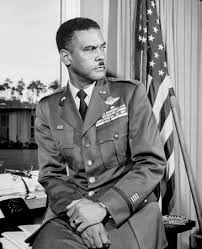
On this day in 1959, Benjamin O. Davis Jr. was promoted to brigadier general, becoming the first African American general in the U.S. Air Force. A trailblazing pilot, officer, and administrator, Davis broke racial barriers in a military still grappling with segregation. He would later rise to the rank of major general, becoming the first African American to achieve that level in the Air Force.
Davis Jr. was the son of Benjamin O. Davis Sr., who made history as the first Black general in the U.S. Army, marking the Davis family as a powerful legacy of military excellence and perseverance against the odds.
In a 2002 interview, legendary singer Chaka Khan revealed how deeply she was influenced by Aretha Franklin early in her career. Back in 1969, while touring with the Shades of Black and the Afro Arts Theater at just 15 years old, Khan had to perform in Philadelphia. Unsure of how to win over the crowd, she decided to channel Aretha Franklin’s soulful vocal style. She gave a little holler, mimicking Aretha’s signature gospel-rooted power—and the audience loved it. That performance marked a turning point. From that day forward, Khan adopted the emotive, commanding style that would define her as one of the greatest voices of the 20th century. She’s credited that moment—and Aretha’s influence—as pivotal to her vocal identity.
On May 22, 1967, Langston Hughes—renowned poet, playwright, and central figure of the Harlem Renaissance—passed away in New York City at the age of 65. Hughes used his work to capture the joys, struggles, and dreams of Black life in America, pioneering a literary voice that remains influential today. His ashes are interred beneath the Schomburg Center for Research in Black Culture, marked by a mosaic titled “Rivers,” in honor of one of his most famous poems.
On this day, Bill Cosby made history as the first African American to win the Emmy Award for Best Actor in a Dramatic Series. He earned the honor for his groundbreaking role as Alexander Scott in the television series I Spy. This win marked a pivotal moment in television history, challenging racial barriers and opening the door for greater representation of Black actors in leading roles on primetime television.
Amid escalating violence against Freedom Riders in the South, U.S. Attorney General Robert F. Kennedy ordered 200 additional U.S. Marshals to Montgomery, Alabama. The move came after white mobs brutally attacked interracial groups challenging segregation in interstate travel. This federal intervention marked a significant moment in the Civil Rights Movement, demonstrating growing national pressure to protect civil rights activists.
Claude McKay, a pioneering poet and novelist of the Harlem Renaissance, dies at age 58. Known for works like Home to Harlem—the first best-selling novel by an African American—McKay’s writings boldly explored race, identity, and resistance. His work helped define a literary era and continues to influence generations of writers.
On May 22, 1940, Bernard Shaw was born in Chicago, Illinois. A pioneering African American journalist, Shaw became CNN’s chief anchor and was a key figure during the network’s rise in prominence. He was widely respected for his calm, authoritative coverage of major global events, including the Gulf War in 1991, where he reported live from Baghdad during bombings. His legacy opened doors for future generations of Black journalists in broadcast news.
On May 22, 1863, the U.S. War Department established the Bureau of Colored Troops, a pivotal move during the Civil War. This bureau facilitated the recruitment of African American soldiers into the Union Army, leading to the formation of units like the United States Colored Troops (USCT). These brave men played a crucial role in turning the tide against the Confederacy, demonstrating valor and resilience despite facing discrimination and unequal treatment. Their contributions not only bolstered the Union\’s military strength but also challenged prevailing prejudices, laying the groundwork for future civil rights advancements. The establishment of the Bureau marked a significant step toward recognizing African Americans\’ rights and capabilities, influencing the nation\’s journey toward equality.
On this day in 1917, Ell Persons, an African American man, was brutally lynched by a mob in Memphis, Tennessee. Accused without substantial evidence of a heinous crime, he was burned alive before a crowd of thousands in a carnival-like atmosphere. This atrocity highlighted the rampant racial violence and injustice prevalent in the early 20th-century American South. The lynching galvanized local African American communities, leading to the establishment of the Memphis chapter of the NAACP. A century later, in 2017, memorials were erected to honor Persons\’ memory and acknowledge this dark chapter in history, serving as a reminder of the ongoing struggle for racial justice.
\”Shuffle Along,\” the first major African American musical, premiered on Broadway on May 22, 1921. Created by Noble Sissle and Eubie Blake, this groundbreaking production broke racial barriers in the performing arts, featuring an all-Black cast and creative team. The show\’s success challenged prevailing stereotypes and opened doors for Black performers and playwrights in mainstream theater. Its hit song, \”I\’m Just Wild About Harry,\” became a cultural phenomenon. \”Shuffle Along\” not only entertained audiences but also played a significant role in the Harlem Renaissance, influencing generations of artists and reshaping American musical theater.


© 2026 KnowThyHistory.com. Know Thy History