
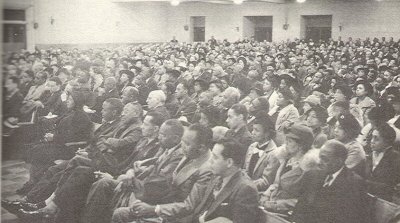
On May 8, 1925, the Brotherhood of Sleeping Car Porters (BSCP) was officially organized, becoming the first major African American labor union in the United States. Led by civil rights pioneer A. Philip Randolph, the BSCP fought for better wages, working conditions, and dignity for Black railway porters employed by the Pullman Company. Despite fierce opposition, the union secured a collective bargaining agreement in 1937, marking a historic victory for Black labor rights. The BSCP’s success laid the foundation for greater involvement of African Americans in organized labor and was a critical stepping stone in the broader civil rights movement.
On May 8, 1945 — the same day World War II officially ended in Europe — a peaceful demonstration in the Algerian town of Sétif turned into a bloodbath. Thousands of Algerians, demanding freedom and equality from French colonial rule, marched through the streets waving nationalist flags. When tensions escalated, French police opened fire. What followed was a brutal crackdown: French colonial forces, aided by settler militias and aerial bombardments, slaughtered Algerians across Sétif, Guelma, and Kherrata. Estimates of the dead vary, but Algerian sources report as many as 45,000 lives lost. This massacre is widely regarded as a turning point that fueled Algeria’s 17-year-long war for independence, culminating in liberation in 1962.
On May 8, 1958, President Dwight D. Eisenhower ordered the removal of the federalized Arkansas National Guard from Central High School in Little Rock. The troops had been deployed the previous fall to enforce the desegregation of the school and protect the “Little Rock Nine”—a group of nine Black students who integrated the previously all-white institution. This marked the end of a pivotal federal intervention in the civil rights movement, but the struggle in Little Rock continued. That fall, Governor Orval Faubus closed all public high schools in the city to resist integration, igniting the “Lost Year” of 1958–59. Eisenhower’s decision to withdraw federal troops was symbolic of the delicate balance between federal authority and states’ rights during one of the most volatile chapters of American education history.
On May 8, 1945, Nazi Germany officially surrendered to the Allied Forces, marking Victory in Europe Day (V-E Day) and the end of World War II in Europe. While crowds cheered across the U.S. and Europe, over one million African American soldiers who had served in segregated units were often left out of the national narrative. Despite fighting heroically in battles like the Battle of the Bulge and serving in critical roles as engineers, pilots, and medics, Black troops returned home to continued discrimination and limited recognition. V-E Day stands as a powerful reminder of both their patriotism and the racial injustice they faced, even in victory.
On May 8, 1932, heavyweight boxing legend Charles “Sonny” Liston was born in St. Francis County, Arkansas. Known for his intimidating presence and devastating punching power, Liston rose from a troubled youth to become one of boxing’s most feared champions. He amassed a record of 50 wins (39 by knockout) out of 54 total fights. His defining moment came in 1962 when he delivered a stunning first-round knockout against Floyd Patterson to claim the World Heavyweight Title. Though his career was later overshadowed by two infamous bouts with Muhammad Ali, Liston remains a towering figure in the sport’s history and a symbol of raw, untamed talent.
On May 8, 1915, Bishop Henry McNeal Turner passed away at the age of 82. A towering figure in 19th-century Black leadership, Turner was the first African American chaplain in the U.S. Army, appointed during the Civil War in 1863. Beyond his military service, he was a fiery orator, newspaper editor, Georgia state legislator during Reconstruction, and one of the most influential bishops of the African Methodist Episcopal (AME) Church. Turner was also an outspoken advocate for Black self-determination and African repatriation, arguing that freedom required full control over Black destiny. His death marked the end of an era for both church and civic leadership.
On May 8, 1910, Mary Lou Williams was born as Mary Elfrieda Scruggs in Atlanta, Georgia. A child prodigy on the piano, she would grow into one of the most influential figures in jazz history. Over a prolific five-decade career, Williams shattered gender barriers by excelling not only as a pianist but also as a composer and arranger—roles rarely afforded to women in the male-dominated jazz scene.
Williams worked with legends like Duke Ellington, Benny Goodman, and Thelonious Monk, and her compositions shaped the swing, bebop, and modern jazz movements. She arranged for the biggest bands of her time and later became a mentor to emerging musicians, including Dizzy Gillespie and Miles Davis. Her spiritual and avant-garde compositions in the later years of her life reflected a deep commitment to both musical and social transformation.
Mary Lou Williams remains a towering example of artistic mastery and resilience, and a pioneer whose legacy continues to inspire generations of musicians—especially women in jazz.
On May 8, 1876, Truganini, a Nuenonne woman of the Palawa people and one of the most well-known Aboriginal Tasmanians, died in Hobart at the age of 73. Often falsely labeled “the last full-blooded Tasmanian Aboriginal,” her death was weaponized by colonial authorities to promote the idea that Tasmanian Aboriginal people had become extinct—a dangerous myth that lingers in public consciousness even today.
Truganini had witnessed and endured the devastating impacts of genocide, forced relocation, and the Black War. Her story became a symbol of resilience and trauma under British colonization. In truth, many Aboriginal Tasmanians survived and continued their cultural lineage. The Palawa community remains strong, and the false narrative of extinction continues to be challenged by scholars and descendants alike.
On May 8, 1858, two major milestones in Black history and the fight against slavery occurred. In Chatham, Ontario, radical abolitionist John Brown convened a secret antislavery convention attended by twelve white and thirty-four Black delegates. There, Brown presented his revolutionary plan to establish a free state for formerly enslaved people and proposed his “Provisional Constitution” — laying the ideological groundwork for the later raid on Harpers Ferry.
That same year, abolitionist and author William Wells Brown, a formerly enslaved man, published The Escape; or, A Leap for Freedom, the first play ever written by a Black American. Blending narrative drama with social critique, Brown’s work was a bold literary step toward shaping African American theatrical expression and advancing the abolitionist message through art.
While imprisoned in Birmingham, Alabama, Dr. Martin Luther King Jr. continued to inspire global movements for civil rights. On May 8, 1963, King expanded on his \”Letter from Birmingham Jail,\” defending nonviolent protest against segregation. The letter, addressing white clergymen who criticized his tactics, argued that “justice too long delayed is justice denied.” It had a ripple effect far beyond the United States, influencing liberation movements in Africa, the Caribbean, and Asia. King’s appeal for moral urgency resonated internationally, strengthening solidarity among oppressed peoples worldwide and linking the American civil rights struggle to global human rights campaigns.


© 2026 KnowThyHistory.com. Know Thy History