
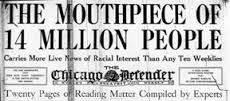
Robert S. Abbott was founded The Chicago Defender with an initial investment of 25 cents. The Defender, which was once heralded as “The World’s Greatest Weekly”, soon became the most widely circulated black newspaper in the country, and made Abbott one of the first self-made millionaires of African American descent. Abbott also published a short-lived paper called Abbott’s Monthly.
On May 5, 1975, Hank Aaron surpassed Babe Ruth’s long-standing record for career runs batted in (RBIs), marking another historic milestone in his legendary baseball career. Already known for breaking Ruth’s home run record the year prior, Aaron’s new RBI achievement solidified his legacy as one of the most prolific hitters in Major League Baseball history. He ultimately retired with 755 home runs and 2,297 RBIs, the latter of which remains the all-time record. Aaron was inducted into the Baseball Hall of Fame on August 1, 1982. After retiring, he continued to influence the game through executive roles with the Atlanta Braves and has had stadiums, streets, and scholarships named in his honor.
On May 5, 1969, Moneta Sleet Jr. made history as the first African American to win a Pulitzer Prize for journalism. He earned the award for his deeply moving photograph of Coretta Scott King, widow of Dr. Martin Luther King Jr., holding their young daughter Bernice at Dr. King’s funeral. The image, captured for Ebony magazine, conveyed the pain and resilience of a grieving family and a mourning nation. Sleet’s win was not only a personal triumph but also a groundbreaking moment for Black photojournalists in a field where African Americans were historically underrepresented.
Moneta Sleet Jr.’s career spanned decades, and he was known for documenting the civil rights movement, from the Montgomery Bus Boycott to the March on Washington. His Pulitzer win symbolized both progress and the power of Black media voices during the era of social change.
On May 5, 1865, Adam Clayton Powell Sr. was born in Franklin County, Virginia. The son of formerly enslaved parents, Powell would rise to become a prominent Baptist pastor and a towering figure in early 20th-century Black America. As senior pastor of the Abyssinian Baptist Church in Harlem from 1908 to 1936, Powell helped grow the congregation into one of the largest and most influential Black churches in the world. Under his leadership, the church expanded its role in community development, civil rights, and education. He laid the foundation for the political rise of his son, Adam Clayton Powell Jr., who became one of the most powerful Black Congressmen in U.S. history.
Mary Prince, born on May 5, 1809, in Bermuda, became the first Black woman to publish an autobiography in Britain, titled The History of Mary Prince (1831). Her firsthand account of the horrors of slavery stirred public emotion and galvanized the abolitionist movement. Prince’s story depicted brutal treatment, family separations, and the dehumanization endured under slavery. She bravely spoke at public meetings and petitioned Parliament, making her a crucial figure in the fight for emancipation in Britain and its colonies.
On May 5, 1821, the African Methodist Episcopal Zion (AME Zion) Church was officially incorporated in New York City. Known as the “Freedom Church,” it played a major role in the abolitionist movement and later the Civil Rights Movement. Leaders like Harriet Tubman and Frederick Douglass were members. The AME Zion Church provided spiritual strength and political advocacy, emphasizing education, civil rights, and racial uplift in African American communities.
On May 5, 1905, Bill “Bojangles” Robinson performed solo on the major vaudeville circuit for the first time, breaking racial barriers. His innovative tap dancing style captivated audiences and transformed American dance. Robinson’s career helped pave the way for future Black entertainers during a time of widespread segregation, and his success inspired the gradual integration of American entertainment venues.
On May 5, 1862, Robert Smalls—a 23-year-old enslaved Black man—led one of the most daring escapes of the Civil War. Along with 12 fellow enslaved crew members, Smalls commandeered the Planter, a Confederate transport ship outfitted as a gunboat. Disguised in the captain’s uniform, he navigated the heavily fortified Charleston Harbor, passed Confederate checkpoints, and successfully surrendered the vessel to the Union Navy. His intimate knowledge of naval protocols and local waterways made the escape flawless. The Planter was welcomed into Union hands, and Smalls was later appointed as the ship’s captain—the first Black man to command a U.S. military vessel. His heroism helped persuade President Lincoln to accept African Americans into the Union Army.
Born on May 5, 1921, in Bluefield, West Virginia, Reverend Charles Kenzie Steele became a leading figure in the Civil Rights Movement. As president of the Inter-Civic Council in Tallahassee, Florida, he helped organize the Tallahassee Bus Boycott of 1956, following the model of Montgomery. Steele later co-founded the Southern Christian Leadership Conference (SCLC) alongside Martin Luther King Jr., promoting nonviolent resistance and racial justice across the South.
On May 5, 1940, the U.S. War Department announced plans to open its first Officer Candidate Schools (OCS) for Black soldiers at Fort Des Moines, Iowa. This was a crucial step toward desegregating the U.S. military. Although the armed forces would not fully integrate until after World War II, the training of Black officers challenged stereotypes and built a cadre of leaders for both wartime service and future civil rights efforts.


© 2026 KnowThyHistory.com. Know Thy History