
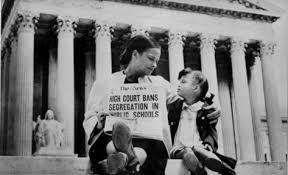
On May 31, 1955, The Supreme Court ruled in what became known as “Brown II,” that the task of carrying out school desegregation was delegated to district courts, with orders that desegregation occur “with all deliberate speed.” Many Southern states and school districts interpreted “Brown II” as legal justification for resisting, delaying, and avoiding significant integration for years—and in some cases for a decade or more—using such tactics as closing down school systems, using state money to finance segregated “private” schools, and “token” integration where a few carefully selected black children were admitted to former white-only schools but the vast majority remained in under-funded, unequal black schools.
On May 31, 1979, Rhodesia was reconstituted as Zimbabwe-Rhodesia under the Internal Settlement agreement, marking the first time a Black prime minister, Abel Muzorewa, led the country. Although widely seen as a step toward majority rule, the transition was met with skepticism. The new government retained white minority influence, and many African nations and the United Nations did not recognize its legitimacy. The move was part of a larger process that eventually led to full independence as Zimbabwe in 1980, under the leadership of Robert Mugabe. May 31, 1979, is significant in the timeline of African liberation, symbolizing a transitional moment when African-led governance began to challenge colonial legacies, despite ongoing foreign and domestic power imbalances. The date highlights the complexities of decolonization and the global Black struggle for self-determination, representation, and authentic sovereignty in post-colonial states. True independence would come nearly a year later, in April 1980, after the Lancaster House Agreement and democratic elections that led to the formation of the Republic of Zimbabwe under Robert Mugabe.
On May 31, 1961, U.S. District Judge Irving Kaufman ordered the Board of Education of New Rochelle, New York, to integrate its public schools. This landmark ruling followed a lawsuit by African American parents who argued that the school board had maintained de facto segregation through zoning policies. Judge Kaufman’s decision marked one of the first northern desegregation rulings post-Brown v. Board of Education and helped set a legal precedent for challenging racial imbalance in schools outside the South.
?Patricia Roberts Harris, born on May 31, 1924, in Mattoon, Illinois, was a trailblazing American politician, diplomat, and legal scholar. She holds the distinction of being the first African American woman to serve in a U.S. presidential cabinet.?Women of the Hall
Harris’s early life was marked by academic excellence and civic engagement. She graduated summa cum laude from Howard University in 1945 and was actively involved in civil rights activities, including participating in one of the nation’s first lunch counter sit-ins in 1943. She later earned a law degree from George Washington University Law School in 1960, graduating first in her class.?WikipediaDiscover LBJ
Her career was characterized by a series of groundbreaking achievements:?
In 1965, President Lyndon B. Johnson appointed her as the U.S. Ambassador to Luxembourg, making her the first African American woman to hold an ambassadorial position. ?Women of the Hall
In 1969, she became the first African American woman to serve as dean of a U.S. law school at Howard University. ?Encyclopedia Britannica
In 1977, under President Jimmy Carter, Harris was appointed Secretary of Housing and Urban Development, becoming the first African American woman to serve in a presidential cabinet. ?Wikipedia
She later served as Secretary of Health, Education, and Welfare, and continued as Secretary of Health and Human Services after the department’s reorganization in 1980. ?Encyclopedia Britannica
Beyond her government service, Harris was a pioneer in the corporate world, becoming the first African American woman to serve on the board of directors of a Fortune 500 company, IBM. ?Women’s Voices Media
Patricia Roberts Harris passed away on March 23, 1985, leaving behind a legacy of public service and breaking racial and gender barriers in American politics and society.
On May 31, 1921, one of the most devastating acts of racial violence in American history began in the Greenwood District of Tulsa, Oklahoma—widely known as “Black Wall Street.” Over the course of 18 hours, white mobs, some deputized and armed by local officials, looted and burned the thriving Black community to the ground.
The massacre left more than 15,000 Black residents homeless, with 1,500 homes destroyed and over 600 Black-owned businesses—including hotels, newspapers, banks, schools, and hospitals—reduced to ashes across a 35-square-block area. While official counts originally reported 36 deaths, modern scholarship and eyewitness accounts suggest that between 300 and 3,000 people were killed, wounded, or went missing.
Greenwood’s prosperity had made it a target, and its destruction was not spontaneous—it was methodical, coordinated, and even included aerial attacks from private planes dropping incendiary devices.
This event, long suppressed in American historical narratives, is now recognized as a Black Holocaust on American soil—a sobering reminder of the economic and human toll of racial hatred.
On May 31, 1909, approximately 300 Black and white activists gathered at the United Charities Building in New York City for the first official conference of the National Association for the Advancement of Colored People (NAACP). Spanning May 31 to June 1, the historic meeting laid the groundwork for what would become one of the most influential civil rights organizations in American history.
On this day, General Samuel C. Armstrong recommended Booker T. Washington to become the founding principal of the Tuskegee Normal School for Colored Teachers in Alabama. Washington, then just 25 years old, was chosen for his leadership and educational philosophy rooted in self-help, vocational training, and racial uplift. His appointment marked the beginning of one of the most influential educational institutions in African American history, known today as Tuskegee University.
On May 31, 1870, the U.S. Congress passed the Enforcement Act of 1870 to uphold the 15th Amendment, which granted Black men the right to vote. This legislation aimed to prevent voter suppression by outlawing discrimination at the polls and authorizing federal oversight of elections. It was a critical piece of Reconstruction-era civil rights legislation, addressing the violent backlash by white supremacist groups like the Ku Klux Klan. Although enforcement was inconsistent and often undermined, the law marked one of the earliest federal attempts to protect Black political participation. May 31, 1870, is a crucial date in the history of Black suffrage, underscoring the fragile nature of voting rights and the ongoing struggle against systemic suppression. The Enforcement Act laid the groundwork for later civil rights laws and reminds us that protecting democracy requires vigilance, especially when racial equity is at stake.
On May 31, 1961, the Republic of South Africa officially left the British Commonwealth after facing mounting pressure over its apartheid policies. The decision followed a whites-only referendum in 1960 and marked the country’s full embrace of institutionalized racial segregation. This withdrawal intensified global scrutiny and fueled anti-apartheid movements around the world. Key African nations like Ghana and Nigeria had already called for economic sanctions, and South Africa’s isolation on the international stage continued to grow. This milestone spurred increased efforts by the African National Congress (ANC) and Pan Africanist Congress (PAC), leading to decades of global solidarity, divestment campaigns, and United Nations resolutions. The apartheid government remained entrenched until 1994, but May 31, 1961, stands as a turning point when international diplomacy began to more forcefully challenge state-sponsored racism. This date is crucial in understanding how global Black resistance and international politics intersected to fight oppression.
On May 31, 1963, the final dissolution of the West Indies Federation was confirmed, ending a short-lived political union of Caribbean territories under British colonial rule. Formed in 1958, the Federation aimed to unite ten English-speaking Caribbean islands into a single independent state. However, internal disagreements, especially between Jamaica and Trinidad and Tobago, led to its collapse. Jamaica withdrew after a 1961 referendum, and Trinidad followed, opting for separate independence. The dissolution underscored the complexities of Caribbean unity and the lingering effects of colonial divisions. While the Federation failed, its legacy lives on in organizations like CARICOM, which continue to pursue regional integration. May 31 represents a pivotal date in Black international history when postcolonial dreams of unity clashed with national interests, shaping the path of Caribbean independence movements and influencing how diaspora nations build cooperative futures today.


© 2026 KnowThyHistory.com. Know Thy History